
The lightning gets your attention. The symbols keep moving. Then a multiplier appears, and suddenly the number on the screen needs a second look.
That is the appeal of Gates of Olympus: there is more to follow than a set of reels coming to a stop. A winning sequence can unfold in stages, with falling symbols and multipliers giving each stage its own moment.
For readers browsing our PH8 slot information, it helps to understand what those moments mean. Which symbols produce a payment? What starts the free spins? And why do videos of apparently the same game show different features?
This article explores the original Gates of Olympus slot and two related editions: Gates of Olympus 1000 and Gates of Olympus Super Scatter. It explains their features without assuming that PH8 currently offers every version.
Meet the Game Behind the Zeus Videos
If you recognise the Zeus character but have been searching for “God of Olympus,” the Pragmatic Play title discussed here is Gates of Olympus.
The name matters when looking up rules. A video, screenshot, or game description may feature a different edition, even when the artwork looks familiar. Read the complete title before assuming that the same features apply.
Pragmatic Play describes the original through its tumbling reels, matching-symbol payments, multiplier symbols, and free-spins feature. Zeus provides the theme, while those mechanics explain what happens during play. Source: Pragmatic Play’s original Gates of Olympus page
The interesting part is learning to follow the action. Once you can separate a symbol payment from a multiplier or bonus trigger, a busy screen becomes much easier to read.
How to Play Gates of Olympus: Understand the Screen First
If you are wondering how to play Gates of Olympus, begin with its symbol-counting system.
In the original game, eight or more matching symbols can pay anywhere on the screen. They do not need to sit along a traditional fixed payline. Winning symbols disappear through the tumble feature, making room for replacements. Source: Gates of Olympus game mechanics
That changes what you should watch. Rather than tracing a line from left to right, notice which symbol type the game identifies and how many matching symbols are present.
For example, several different gems do not become one matching group simply because they are all gems. The paytable defines the symbol types and the payments associated with them.
Before interacting with any version, open its information panel. Find the symbol values, feature rules, and explanation of the controls. Understanding those details is more useful than copying someone else’s clicks from a video.
Why One Round Can Have Several Moments
A tumble gives a round a sense of movement. Instead of ending with the first displayed result, the screen changes as symbols are removed and replacements arrive.
When watching a replay, try following the sequence in three parts:
- Identify the initial result.
- Watch what changes during the tumble.
- Wait for the sequence to finish before interpreting the final amount.
This simple approach prevents a common misunderstanding: treating every stage in an animation as a separate paid spin.
It also makes the game more interesting to observe. You can follow what the interface is showing rather than relying on sound effects or an excited reaction to tell you whether something important happened.
Still, an eventful round is only that round. It does not tell you what the next one will produce.
Multipliers: Watch the Amount Behind the Number
A large multiplier is easy to notice. Understanding what it multiplies takes a little more attention.
The original Gates of Olympus includes multiplier symbols with values up to 500x. Its free-spins feature starts with 15 spins when four or more scatters appear, and qualifying multipliers contribute to a running total during that feature. Source: Original game features
The key reading skill is identifying the amount to which a multiplier applies.
Imagine a hypothetical calculation in which a qualifying win is 12 credits and the applicable multiplier is 5x:
12 credits × 5 = 60 credits
That example explains multiplication, not the complete settlement rules of every Gates of Olympus edition. You still need the relevant game rules to establish when a multiplier applies and which amount it affects.
When a video flashes an impressive number, pause long enough to ask: “What was multiplied?” That question often tells you more than the animation.
Gates of Olympus 1000: What Changes?
Gates of Olympus 1000 keeps the recognisable Zeus presentation while increasing the available multiplier-symbol range.
According to Pragmatic Play, it uses a 6×5 grid, with payments beginning at eight matching symbols anywhere on the screen. Multiplier symbols can take values from 2x to 1,000x. Their values combine at the end of a tumble sequence and apply to the win.
The developer also describes 15 initial free spins from four or more scatters, with five additional spins awarded when three or more scatters appear during the bonus. Source: Gates of Olympus 1000
If you open a Gates of Olympus 1000 demo, make sure the title includes “1000.” This is particularly helpful when comparing a demonstration with a tutorial: both should refer to the same edition.
A larger multiplier ceiling tells you about a possible feature value. It does not, by itself, tell you how often a particular outcome occurs or what a session will return.
Gates of Olympus Super Scatter: A Different Feature to Watch
Gates of Olympus Super Scatter introduces an additional award connected to Super Scatter symbols when the feature is triggered.
Pragmatic Play describes the awards as follows:
| Super Scatters present while triggering the feature | Stated award |
|---|---|
| One | 100x the bet |
| Two | 500x the bet |
| Three | 5,000x the bet |
| Four | 50,000x the bet—the stated maximum win |
The phrase “while triggering the feature” is essential. These figures should not be interpreted as payments whenever one of these symbols appears in any situation. Source: Gates of Olympus Super Scatter
That distinction is worth watching in a Gates of Olympus Super Scatter demo. Look at the complete trigger and the displayed explanation, rather than only the final award.
A short clip can leave out precisely the detail that explains the result. Seeing the title, trigger, and outcome together gives you a much clearer picture.
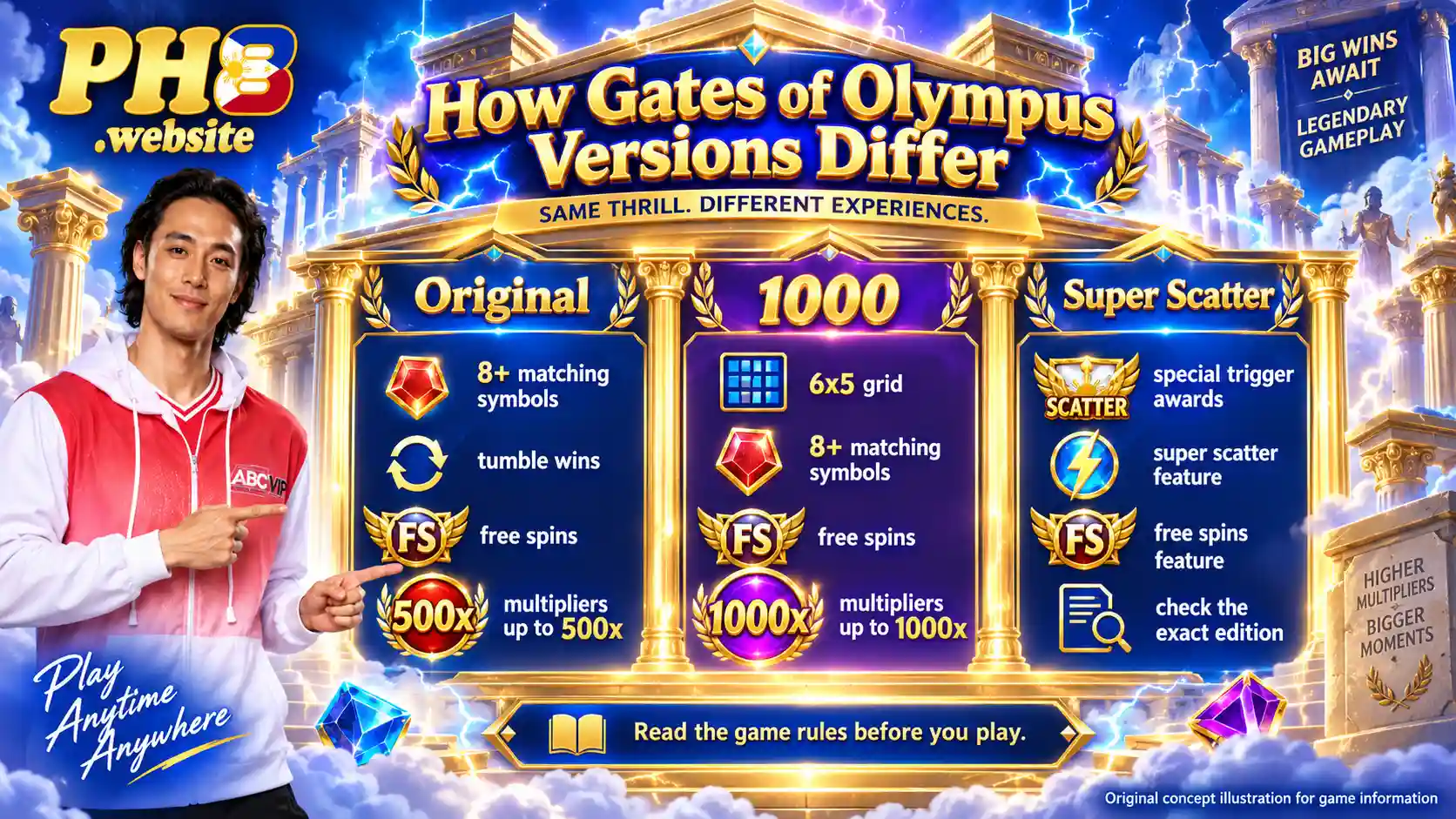
Which Version Are You Looking At?
The similar names make it easy to mix up the editions. Use this quick comparison when reading an article or watching a replay.
| Edition | Main distinction covered here |
|---|---|
| Gates of Olympus | The original multiplier and free-spins structure |
| Gates of Olympus 1000 | Multiplier symbols reaching 1,000x |
| Gates of Olympus Super Scatter | Additional Super Scatter awards tied to triggering the feature |
These are selected editions, not a complete catalogue of every Olympus-themed release.
Before comparing two results, check that they come from the same game and mode. A feature demonstrated in one edition should not automatically be expected in another.
The title is your starting point. The information panel supplies the details.
What Can You Learn From a Gates of Olympus Demo?
A Gates of Olympus demo, where available, can help you become familiar with the interface without treating every animation as a mystery.
Use it to answer practical questions:
- Where are the game rules and paytable?
- Which symbols belong to ordinary payments?
- Which symbols relate to a feature?
- Where does the interface show the result of a sequence?
- Can you follow a multiplier calculation from beginning to end?
For a Gates of Olympus 1000 demo, focus on the rules specific to that edition. For a Gates of Olympus Super Scatter demo, pay particular attention to the difference between the feature trigger and the associated Super Scatter award.
Demo credits are not withdrawable money. A successful demonstration also does not predict the outcome of future play.
Pragmatic Play maintains separate pages for these titles, but demo access may depend on location and availability. This article does not provide an embedded game or promise unrestricted access.
RTP: Why One Session Cannot Tell the Whole Story
RTP, or return to player, describes a theoretical return across a large volume of play. It is not a promise about the amount an individual will receive during a short session.
For example, a hypothetical 96% RTP does not mean every 100 credits used will return exactly 96 credits. Individual results can differ substantially.
The UK Gambling Commission explains that RTP concerns an average over significant play, rather than a fixed return each time someone participates. Source: Understanding return to player
Check the information shown in the exact game you open. Do not assume a percentage quoted for one edition or configuration applies everywhere.
Volatility is a separate idea concerning variation in outcomes. A maximum award, an RTP figure, and the frequency of payments describe different aspects of a game. Source: RTP and volatility definitions
Is There a Winning Time or Pattern?
It is tempting to look for patterns when several rounds have similar results. You might see a comment claiming that a particular hour is better, or that a large multiplier becomes more likely after a run of disappointing outcomes.
The official game descriptions reviewed for this article do not establish a winning timetable or a method for predicting the next result from previous spins.
As a general regulatory reference, the UK Gambling Commission’s remote technical standards require random outcomes to be unpredictable and prohibit adaptive behaviour that changes outcome probabilities during play. This is a regulatory standard, not certification of a particular PH8 implementation. Source: Random-outcome standards
A video showing a successful attempt cannot establish that the player’s timing caused it. Understanding a feature is useful; interpreting it as a signal to spend more is an unsupported step.
How to Watch a Winning Clip With Better Context
Winning clips can be entertaining, but they usually tell only part of a story.
Before drawing a conclusion, ask:
- Which edition is shown? Read the complete title.
- What mode is being used? Establish whether the clip shows demo credits or another mode.
- What amount is involved? Look for the stake and the displayed units.
- Is the whole sequence visible? A cropped clip may omit the trigger or earlier stages.
- Is the payment being confused with profit? One round does not reveal the cost of the entire session.
These questions do not take away the spectacle. They help you understand what you are actually seeing.
Frequently Asked Questions
Who made the Gates of Olympus slot?
Pragmatic Play developed Gates of Olympus. Check the developer and full game title when comparing similarly named products.
Are Gates of Olympus 1000 and Super Scatter the same game?
They are separate editions. Their familiar presentation should not be taken to mean that all their features and rules match.
Can a demo show me how to win consistently?
No. A demonstration can help explain the controls and mechanics, but a short run cannot establish a reliable method for predicting future results.
Is Gates of Olympus available on PH8?
This article does not verify PH8’s current game catalogue. Confirm availability, the exact edition, and applicable service information independently.
Enjoy the Details Behind the Spectacle
There is more to Gates of Olympus than its lightning effects. Following the symbol counts, tumble sequences, multiplier calculations, and feature triggers makes the game easier to understand—and makes comparisons between editions more meaningful.
Start with the full title. Read the rules. Treat a demonstration as a way to learn the interface, rather than evidence of what will happen next.
Explore the PH8 article collection for more game explanations. If you choose to participate in gambling, avoid chasing losses and read our responsible-gaming information before making financial decisions.